
The 5 Second Rule: Fact or Myth?
This research paper has been written and edited by Haniya Malik. Click below to find out more about her. It is also worthy to note that this research paper has been submitted for the Bronze CREST Award. Feel free to check out my blog too!
Click Here
The aim of this project is to investigate whether the “5 second rule” holds any scientific validity, as well as the consequences of this rule if it were to be implemented in daily life situations.
My objectives are :
- To safely and accurately conduct this experiment on whether the 5 second rule holds any veracity when conducted on different surfaces.
- To practice and hone my practical science skills
- To enhance my knowledge on bacterial growth
- To investigate modern myths on food and bacteria
This project is important as its aim is to uncover the extent of scientific veracity in the “5 Second Rule”. Performing this experiment may prevent any cases of severe illness, due to the consumption of pieces of food that have been exposed to unclean surfaces, and thus have undergone microbial contamination.
This project can be done in several ways. For instance , I could just take a survey to collect data on the number of people who believe in the 5 second rule and under what conditions. However , this method will only collect biased data, and , even if there is a majority of responses supporting a certain idea, without any evidence, these results can be proven false and scientifically inaccurate.
Another potential method could be conducting an experiment in controlled conditions to gain primary data, which I can then analyse and evaluate. Whilst this method is more accurate than the prior one, conducting an experiment will possibly be quite time-consuming , especially since, in this experiment, bacterial growth will most certainly be involved. In the experiment, I can experiment on different foods as well as different surfaces in order to show the reproducibility of results, though this may prove difficult as some foods may be hard to test.
One final method would be analysing existing data, and forming a literature review on the topic. Such a method would also be quite accurate, as generally, public research projects written on certain topics have been formed due to extensive research and experimentation. However, whilst this method is perhaps the most accurate out of all methods mentioned, conducting the investigation in this way would mean the absence of any experimentation on my behalf. This would consequently mean that I will not be able to put any of my scientific knowledge and skills into practice, meaning that one of my objectives, which was to hone my practical science skills, will not be achieved. Furthermore, there may be a few exceptions to the idea that all research projects have been published after in-depth research and experimentation, or there is the possibility that their results were not accurate, hence leading to an invalid investigation.
I will commence with this investigation by conducting a certain extent of research on the “5 Second Rule” to gain a vague idea of what to expect in the practical experiment that I will undertake afterwards. This approach has been chosen to not only streamline the amount of time taken to achieve my objectives and the investigation’s aim , but also to ensure that the overall experiment is more scientifically accurate. I will then rigorously analyse and evaluate the results obtained , and then shift my focus to writing a thorough investigation that communicates my results in the best way possible.
Since I am working on this project with my friend, I will meticulously cover the amount of hours I need to spend on each area of this investigation to achieve the minimum required 10 hours, thus allowing my partner and I to stay coordinated. This, of course, does not apply to the practical investigation which will be conducted in school during lunch time. I will spend the first 2 hours for planning, followed by 1 hour of research, 1 hour of active time for practical investigation [the 3 days mentioned later on in this project is passive time and thus is not counted in the 10 hour minimum], 2 hours for evaluating, analysing and summarising results, and the rest of the time finalising the report, communicating my ideas effectively. I have noted that these allocated hours are rough guidelines for how much time I should spend on each area of this investigation, and that I may run over-time due to factors affecting the experiment.
The equipment needed is as follows:
- 6 petri dishes
- 6 biscuits of the same type
- 6 swabs
- 1 stopwatch
- An incubator
- Disinfectant wipes
The variables are as follows :
- Control Variable: The type, volume, and surface area of biscuits used from the same packet, the duration of each petri dish’s incubation
- Independent Variable: The surface
- Dependent Variable: The amount of colonies and spores that have formed [bacterial growth]
The risk assessment is as follows:
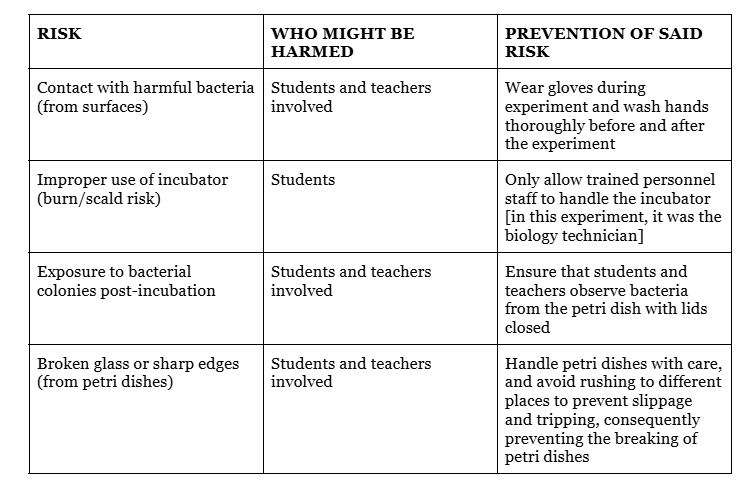
My method for the practical experiment will be as follows:
- Wash our hands.
- Then, take a swab of a regular biscuit and scrape it against the agar jelly in the petri dish: this will serve as the control of the experiment. Agar jelly is used as it provides the correct nutrients needed for bacteria to grow.
- Take some biscuits and drop them onto the different surfaces [on grass, on concrete, on the bathroom floor, on the changing room floor and on wooden tiles] for 5 seconds, using a stopwatch.
- Gently rub a sterile cotton swab across the biscuit and scrape these swabs onto the allocated, labelled petri dishes, before closing the lid. Ensure that the petri dish’s lid is not completely closed to allow the bacteria sample to respire. This is important as the bacteria requires energy to grow : this energy is obtained through aerobic respiration.
- Repeat steps 1-3 for each type of surface
- Next , place the petri dishes into an incubator and allow 3 days for the bacteria to grow. The incubator is essential as it provides the optimum temperature of 37 degrees celsius, hence allowing an increased rate of bacterial growth.
- After incubation time, which in this case will be 2 days, take the petri dishes out of the incubator, observe and record the amount of bacterial colonies and spores that have grown, representing the results in a bar chart. Furthermore, compare the different petri dishes to see the amount of bacterial growth, and take pictures as evidence for the experiment.
NOTE: My partner and I have had previous experience with an experiment like this in the previous year, when we did something similar in class. This method has been derived from that.
In this experiment, my partner and I used the science lab during lunch breaks to prepare equipment, before spending time visiting different areas in the school [the ones mentioned in the method] and performing our experiment. The biology technician at our school aided us by handling equipment that we were not able to use due to school safety guidelines. When we did not get the results we expected, which shall be explained later on in this report, the technician supported us by helping us examine the different petri dishes, keeping our spirits high.
Before the experiment, my partner and I researched different aspects of bacteria, particularly bacterial contamination, through search engines like Google, reading extensively through the websites recommended by the algorithm. Bacterial contamination occurs when bacteria multiply on food, causing it to spoil. With it being one of the predominant causes for foodborne illnesses, otherwise known as food poisoning, bacteria contamination can cause symptoms such as an upset stomach, loss of appetite, headaches, nausea and diarrhea. The main types of bacteria that cause foodborne illnesses are:
- Salmonella
- Clostridium perfringens
- Campylobacter jejuni
- Staphylococcus aureus
Bacteria require certain conditions to grow and function. While bacteria have varying diets that aid in their growth, they all require energy obtained from nutrients. Bacteria utilise substances such as carbon, nitrogen, phosphorus or sulfur from their nutrient source to produce energy. These are broken down during cellular respiration to produce a coenzyme called adenosine triphosphate [ATP], an efficient energy-carrying molecule that aids in metabolic, chemical processes. Other types of bacteria get their energy from sunlight using unique metabolic methods. Bacteria also require certain temperatures, pH levels, concentrations of oxygen and nutrients, and moisture, all of which aid in their growth and functioning. Scientists control all of these conditions when experimenting on bacteria in order to yield valid, accurate results.
Results are as follows:
THE CONTROL:
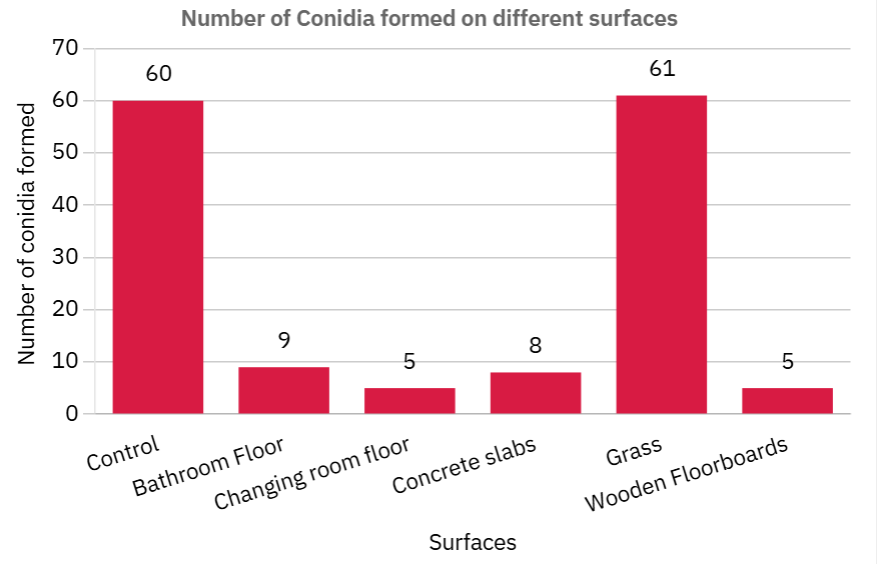
The control involved scraping a swab against a regular biscuit found in a packet. 60 bacterial colonies were recorded over the span of 2 days.
GRASS:
This involved scraping a swab against a biscuit that had fallen on a grassy plane at school for 5 seconds. 61 bacterial colonies were recorded over the span of 2 days.
THE CHANGING ROOMS:
This involved scraping a swab against a biscuit that had fallen on the floor of one changing room at school for 5 seconds. 5 bacterial colonies were recorded over the span of 2 days.
WOOD:
This involved scraping a swab against a biscuit that had fallen on wooden floorboards at school for 5 seconds. 5 bacterial colonies were recorded to have grown over the span of 2 days.
OUTSIDE:
This involved scraping a swab against a biscuit that had fallen on concrete slabs outside within school grounds for 5 seconds. 8 bacterial colonies were recorded over the span of 2 days.
BATHROOM:
This involved scraping a swab against a biscuit that had fallen on the bathroom floor at school for 5 seconds. 9 bacterial colonies were recorded over the span of 2 days.
Graph [bar chart] of results is as follows:
The conclusion is as follows:
My partner and I concluded that since the petri dish labelled grass comprised the most bacterial colonies, amassing a total of 61 bacterial colonies, the surface that transfers the most microorganisms is grass. One possible explanation is that grass is not a disinfected surface, with it constantly being exposed to different external contaminants such as animal excretions and human pollutants. Moreover, grass is in contact with moist, nutrient-dense soil, hence providing the optimal environment for bacteria and other microorganisms to thrive and grow [this knowledge was found through previous research].
The results also show that, excluding grass, the rate of bacterial growth on various surfaces in decreasing order was the control, the bathroom floor, followed by the concrete slabs found outside and, finally, wooden floorboards and the floors of the changing rooms. These results suggest that perhaps surfaces exposed to moisture aid in bacterial growth, though the result obtained from the control complicates this, as, although the sample was taken from a biscuit immediately taken out of its packaging, it showed the second-fastest bacterial growth.
This unexpected result may imply an experimental mistake. Alternatively, the composition of the packaging played a role in such rapid growth, proving moisture alone is not sufficient enough to ensure rapid microbial proliferation: instead, a combination of factors are needed to expedite the rate of bacterial culture development. However, this is quite unlikely, as the sterile packaging the control was taken from was sealed, meaning that it was not possible for bacteria to enter and make contact with any of the biscuits, unless there was contamination during manufacturing or packaging or the sugar and starch content of the biscuit provided enough nutrients to influence bacterial growth.
In the end, my partner and I concluded that an experimental error was the most likely explanation for the control’s results.
The evaluation is as follows:
I believe our project was a mixed success. It went well because we were able to prove that the 5 second rule holds no truth and is in fact a myth, hence fulfilling the predominant objective of this investigation. Furthermore, through both the experiment and research, I was able to enhance my knowledge on microbial proliferation, thus meeting another one of my aims. My partner and I were also able to make valid conclusions from an objective perspective, which shows effective scientific skills.
However, the experiment used to obtain the results mentioned may be less accurate due to a number of factors. For instance, in this experiment, albeit our method mentions the use of gloves to obtain a swab of the control, my partner and I forgot to do this, resulting in an invalid, anomalous result, as bacteria from our hands could have been transferred to the biscuit. This would also explain why the petri dish of the control showed the second-fastest microbial growth. This could have been prevented had we washed our hands and used gloves, thus enhancing the accuracy of the whole investigation. In addition to this, it is worthy to note that no proper spores formed, which is likely to have been caused by insufficient incubation time and systematic errors made throughout the experiment.
In order to improve the experiment, perhaps a repetition is necessary to eliminate all possibilities of systematic errors, and either showing the repeatability of our results, or gaining more credible conclusions from a valid set of data. 3 repetitions and taking an average of all valid results should be sufficient. In the repetitions, it will be best to properly disinfect our hands with antibacterial soap or hand wash to prevent the transfer of bacteria from them to our control.
Safety, ethical choices and independent directions we took are as follows:
- We emailed the organiser* at our school, who arranged a time for us to do the experiment.
- With the organiser’s* help, we were able to obtain all the equipment needed for this experiment via the biology technician at our school.
- We immediately disposed of used swabs in a meticulous fashion in order to prevent the spread of viral infection.
- We disinfected any surfaces we had touched after the experiment. An example would be the phone we used to take pictures of the different petri dishes.
- We made sure not to open the lids while observing the bacterial colonies formed in order to prevent the transfer of bacteria through the air.
- We ensured to dispose of the biscuits used in this experiment, and ensured no one consumed them for obvious health and safety reasons.
- There were no ethical issues in this experiment as this experiment did not involve experimentation on humans.
*The organiser was the person who had arranged the Bronze CREST Award at our school.
References for research are as follows:
In the entirety of this experiment, I have learnt about how numerous factors can influence bacterial growth and how to conduct an experiment with key safety and ethical issues in mind. I have learnt about the 5 second rule and how this myth can cause people to experience food contamination and poisoning, impacting their health. In the future, perhaps it’s be wise to follow the method outlined for the experiment more tightly to prevent any systematic errors. Moreover, if I were to repeat this experiment again, I hope that I do not just explore the 5 second rule on different surfaces but rather with different food to show the reproducibility of results.
Overall, this experiment was fairly successful, though there may have been some complications that affected the accuracy and validity of the results.