
Bill Bryson has done it again in chapter two ‘The Outside: Skin and Hair’. With the power of wit and science alone, he has single-handedly convinced me just how wonderful and complex our bodies are. What looks like bits of flesh and skin on the exterior holds an entire kingdom of blood vessels, tissue collections, organ systems and more. It is, to put it simply, mind-boggling. To understand what mesmerising intricacies our body holds, we must start somewhere — the skin, or rather, should I say, the cutaneous system. Bill Bryson opens with the idea that the ten to fifteen pounds of skin stretching over you never fails, unlike organs like the heart and kidneys. No matter how many times we abuse it, the largest organ somehow almost always finds a way to repair itself. Frankly, it’s quite heart-warming to think of such care, to think that: “Our seams don’t burst, we don’t spontaneously sprout leaks.” Such is the phrasing of Nina Jablonski, professor of anthropology at Penn State University, a belle in the cutaneous field.
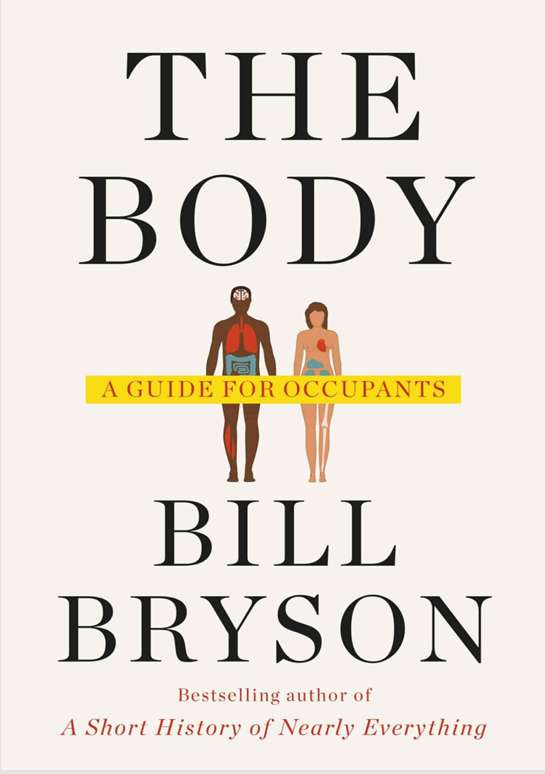
Image of the front cover of Bill Bryson’s book ‘The Body’
To understand what mesmerising intricacies our body holds, we must start somewhere — the skin, or rather, should I say, the cutaneous system. Bill Bryson opens with the idea that the ten to fifteen pounds of skin stretching over you never fails, unlike organs like the heart and kidneys. No matter how many times we abuse it, the largest organ somehow almost always finds a way to repair itself. Frankly, it’s quite heart-warming to think of such care, to think that:”“Our seams don’t burst, we don’t spontaneously sprout leaks.”Such is the phrasing of Nina Jablonski, professor of anthropology at Penn State University, a belle in the cutaneous field.
One of the other fascinating things I came across while reading this chapter was the notion of race. Bryson describes a memorable experience in University of Nottingham in England with the surgeon Ben Ollivere. The surgeon in question peeled back a sliver of skin, a millimetre thick, and I was shocked to read that the colour was … translucent. Skin colour is just a reaction to sunlight, formed from a variety of pigments, and in the biological field, race is given no importance. Considering our human history, and to know that the very thing several have deemed a suitable reason for widespread prejudice and hate is really just insignificant in the whole scheme of things, was quite refreshing.
Speaking of skin colour, did you know that skin colour can be considered a classic example of convergent evolution? Take the light brown skin of Polynesians and Sri Lankans. This beautiful shade of skin tone is not necessarily due to direct genetic links, but because the conditions in which they lived in. The variety of hues humans boast is a result of evolution over years, and I think this ever-changing process is something all of us could stand to be proud of.
Another thing that stuck out to me this chapter was the enigma surrounding fingerprints. We all know from watching crime shows that fingerprints are quite useful in the topography of criminology, and Bryson brings this idea up in what I think is a very interesting piece of lore. He then proceeds to explain that no one really knows what the whorls of fingerprints are actually there for. To drain water? Improve sensitivity? Aid in gripping? We can only hope that some smart mind out there will put in the work, and figure the answer out. And whatever the reason is, I’m positive the answer will be incredible, like everything else about our bodies.
And, how can this be a review of Bryon’s work without mentioning his use of humour? This was a highlight in this segment of his book, especially the passage outlining the mysteries surrounding itching. He really did call me out when he said I, as the reader, was probably feeling an urge to scratch areas that were perfectly fine before he raised the matter. I apologise sincerely if this paragraph has instigated that need in you as well.
Moving on, the hair, though not as deeply discussed as the skin, is still a pretty vital topic in this chapter. Bryson claims that we each grow about twenty-five feet of hair during the spans of our lives, but each strand can ever grow above the length of about three feet, due to a cause of great anxiety for many adults and children alike: hair fall. It apparently occurs due to a hormone called dihydrotestosterone, which increase in production as we age. It’s the reason why hair follicles on the head “shut down”, while more passive ones in the nostrils and ears “spring to dismaying life”. Hair cycles tend to be “staggered”, as Bryson puts it, hence why our day-to-day hair loss is amongst the many other things we never really notice.
Now, I will say I wish we had some more discussion surrounding the hair. It’s clear Bryson’s focus in this chapter was the skin, and while it was still an interesting read, I was hoping for a bit more on things like hair trivia. Perhaps there isn’t enough facts on the hair to write substantially on it — I might do some research on my own, since I kind of find that hard to believe.
Furthermore, I thought that the chapter was a bit too long for my taste [purely a me-thing, of course]. My suggestion would be to perhaps split this chapter into two, one detailing the skin, while the other talks about the hair. In this manner, we get the best of both worlds.
That being said, this chapter was still an enjoyable read. With every concept being thoroughly explained in an understandable and amusing way, Bryson does have a knack for keeping the reader hooked. Can’t wait to read the next chapter!